
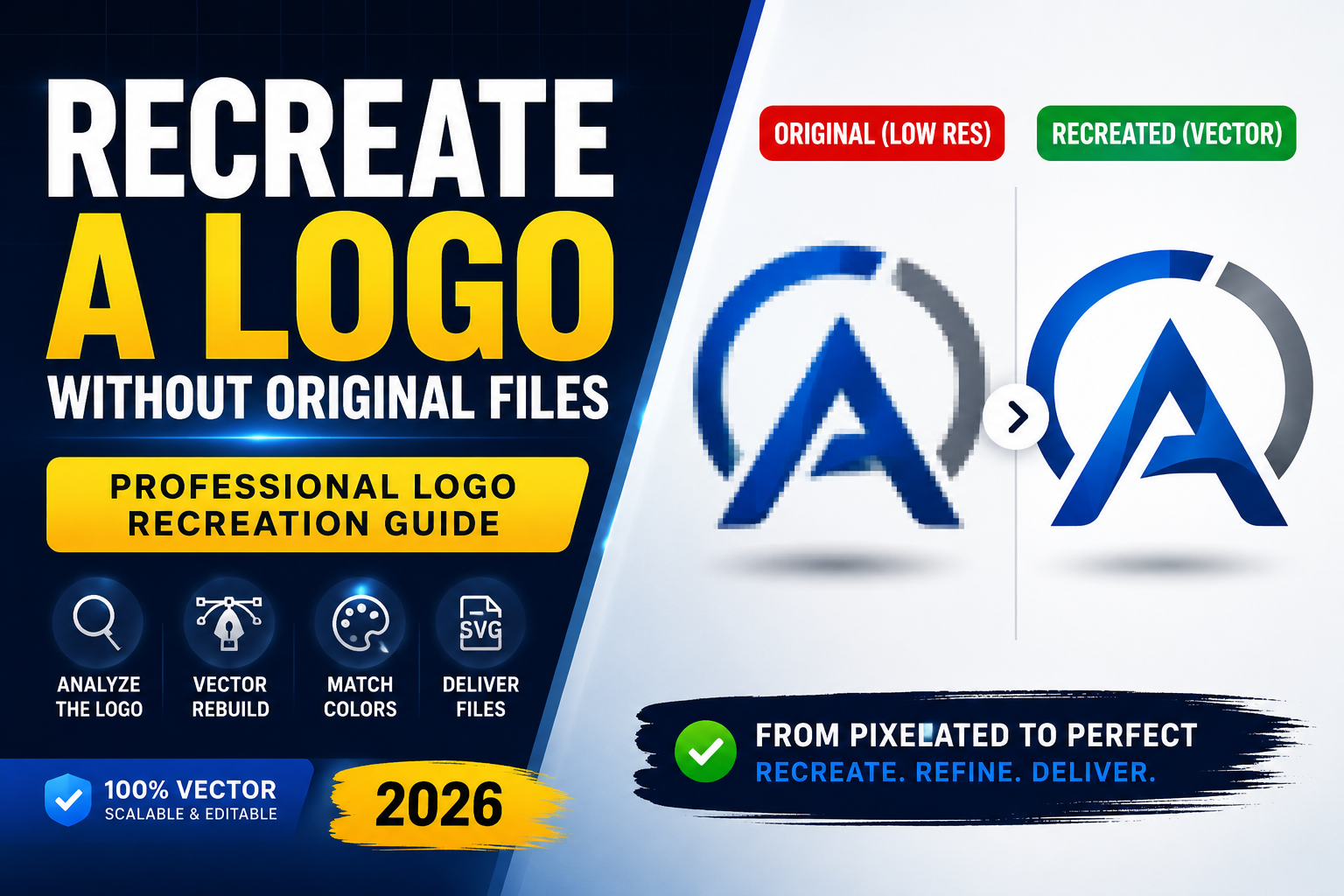
Recreating a logo without original files is one of the most common problems businesses face — and almost always discovered at the worst possible moment.
Why Businesses Need to Recreate a Logo Without Original Files. Recreating a logo without original files is one of the most common problems businesses face — and almost always discovered at the worst possible moment. The print shop is waiting. The embroidery order is due. A new designer is asking for the source files. And nobody can find them.
This situation happens to businesses of every size. A designer leaves and takes the files. A hard drive fails and backups were never set up. The agency that built the brand ten years ago has since closed. The original logo was put together by a family member in PowerPoint and never existed as a proper vector file in the first place. The reasons vary. The problem is always the same: you need your logo, and you do not have the files that make it usable.
The good news is that this is entirely fixable. A professional logo recreation service can rebuild your logo from almost any reference you have available — a screenshot, a photo, a business card, a scan, even a picture taken on a phone. The result is a complete, production-ready vector file package that replaces everything you lost and gives you a solid foundation for your brand going forward.
This guide covers everything you need to know: what the process involves, what references work, what to expect from a professional service, and how to avoid the common mistakes that turn a straightforward recovery into an expensive problem.
Reference quality guide — what works and how well
| Reference type | Accuracy possible | Quality |
|---|---|---|
| High-res PNG from website | Excellent — clear shapes, colors, and proportions for faithful reproduction | Excellent |
| 300 DPI scan of print | Very high — printed items often reveal fine detail that compressed digital files lose | Excellent |
| Well-lit photograph | Good — sharp, straight-on photos taken in daylight give clear shape and color information | Good |
| Screenshot from website | Workable — quality depends on how large the logo appears on screen at time of capture | Good |
| Old degraded printed item | Interpretive — artist reconstructs design intent from whatever detail remains visible | Fair |
| Blurry phone photo | Challenging — fine details may be lost, some design judgment required to fill gaps accurately | Fair |
| Multiple low-quality sources | Often better than one — different sources reveal different details that together improve accuracy | Good |
Recreation process — step by step
| # | Step | What happens | Who |
|---|---|---|---|
| 1 | Submit reference and brief | Upload your best available reference along with color codes, font names, and any context about the original logo design | You |
| 2 | Free assessment and quote | Team reviews your reference and provides exact price and turnaround time — no payment required before this step | Vector artist |
| 3 | Manual reconstruction | Every shape redrawn by hand using the Pen tool — no auto-trace, no shortcuts, judgment calls made throughout | Vector artist |
| 4 | Preview and revision | You review the result against your reference and request any adjustments — revisions are included in all packages | Both |
| 5 | Full file delivery | Complete vector package delivered — AI, EPS, SVG, PDF, PNG, and black and white version ready for any production use | Vector artist |
Package comparison
| Feature | Basic — $25 | Standard — $45 ⭐ | Premium — $85 |
|---|---|---|---|
| Best for | Simple logos, clean reference | Business logos, moderate complexity | Complex or degraded source material |
| 100% manual redraw | ✓ | ✓ | ✓ |
| AI, SVG, PNG files | ✓ | ✓ | ✓ |
| EPS and PDF files | — | ✓ | ✓ |
| Black and white version | — | ✓ | ✓ |
| Embroidery optimization | — | — | ✓ |
| Revisions included | 1 revision | 2 revisions | Unlimited |
| Delivery time | 48 hours | 24 hours | 12–24 hours |
| Free assessment first | ✓ | ✓ | ✓ |
Why You Cannot Simply Use the Logo You Already Have
Before getting into the recreation process, it is worth understanding exactly why the file you have right now — the one that looks fine on your website — cannot just be sent directly to a printer or embroiderer.
The version of your logo that exists on your website, in your email signature, or saved on your phone is almost certainly a raster image. A PNG, a JPG, or a screenshot. Raster images are made of pixels — tiny squares of color arranged on a fixed grid. They look clean and sharp at the size they were created for, but they have a fixed resolution. Scale them up beyond that size and the pixels become visible, edges go soft, and the quality degrades rapidly.
Professional production applications require something fundamentally different. Print shops, sign makers, embroidery digitizers, screen printers, and laser engravers all need vector files. Vector files store artwork as mathematical paths — precise descriptions of shapes, curves, and colors that can be rendered at any size with perfect sharpness. A vector logo looks identical on a business card and a billboard.
When your original vector source files — typically AI or EPS files created in Adobe Illustrator — are lost, you no longer have a production-ready version of your logo. The raster files you have left are not a substitute. They are a reference, not a deliverable. And turning that reference into a proper vector file is what logo recreation is all about.
What References Can Be Used to Recreate a Logo
One of the most common concerns when logo files are lost is whether the available references are good enough to work from. The answer, in almost every case, is yes — though the quality of the reference affects how accurate and straightforward the recreation process will be.
Here is a practical breakdown of common reference types, from most to least useful:
High-resolution PNG or JPG from a website The most common starting point and one of the most workable. A logo downloaded from a website at full resolution gives the vector artist clear information about the shapes, colors, and proportions of the design. Even if the image has anti-aliased edges and some compression artifacts, a skilled artist can interpret the original shapes accurately. If your logo exists on your website, download the largest version available before submitting it for recreation — right-clicking and saving the image file typically gives you more pixels than a screenshot.
Scan of a printed item (business card, letterhead, brochure) A clean scan at 300 DPI or higher of a printed piece containing your logo is an excellent reference. Printed items often reveal details that digital files obscure — ink texture, color accuracy under print conditions, and sometimes small details that compressed digital versions lose. Scan in color at the highest resolution your scanner supports.
Photograph of a sign, vehicle, uniform, or product A well-lit, straight-on photograph of your logo as it appears on physical items can serve as a reference for recreation. Quality matters here more than with scans — a sharp, well-lit photo taken in daylight gives the artist significantly more to work with than a blurry or poorly lit one. If the logo appears on multiple items at different sizes, photograph all of them and provide all the photos.
Screenshot from a website or presentation A screenshot is a lower-quality reference than a downloaded image, but it is usable in most cases. The key limitation is resolution — screenshots capture whatever is currently on screen, which may be a relatively small version of the logo. A screenshot that gives you 200 pixels of logo width is workable but challenging. One that gives you 800 pixels or more is much more useful.
Old printed materials in poor condition Faded, worn, or degraded printed materials can still serve as references, though the recreation process will involve more interpretive judgment. The artist reconstructs the intended design from whatever is still legible, which may require conversations about specific details or comparisons between multiple samples.
A verbal description or rough sketch In rare cases where no visual reference at all is available, a detailed description and rough sketch can serve as the basis for creating a new logo that is consistent with what the original looked like. This crosses from recreation into redesign territory, and the outcome depends heavily on how detailed and accurate the description is.
Whatever you have, provide it. Multiple references from different sources are always better than a single reference — even if each individual one is low quality, together they may fill in details that any single one would leave ambiguous.
The Professional Logo Recreation Process — Step by Step
Understanding what actually happens during a professional logo recreation helps you set accurate expectations and get the best possible result. Here is the full process as it works at Vector Refinery.
Step 1: Submit Your Reference and Brief
You upload your reference material — whatever version of the logo you have available — along with any context that will help the artist achieve an accurate result.
Useful information to include with your submission:
Your brand color codes, if you know them. Pantone numbers, hex codes, or CMYK values help the artist match colors precisely rather than approximating visually from the reference. If you do not know the color codes, include any branded materials you have that show the colors — physical samples are especially useful.
Font information, if you know what typeface was used. Many logos use commercially available fonts that can be identified and matched exactly. If you do not know the font, the artist will use identification tools to find it or the closest match.
Any specific details you remember about the original that may not be visible in the reference. Fine details that were lost to compression or degradation can sometimes be recovered from the memory of someone who worked with the original logo regularly.
The intended use cases for the recreated files. If the primary use is embroidery, that affects how the artist approaches color separation. If the logo will primarily be used for large-format signage, that affects how fine details are handled.
Step 2: Free Assessment and Quote
Before any work begins or any payment is required, the team reviews your reference material and provides a clear assessment. You receive an exact price, a turnaround time, and an honest evaluation of what the recreation process involves for your specific logo.
This is the step that separates professional services from discount platforms. You know exactly what you are getting before committing to anything. If the reference material has significant limitations that will affect accuracy, those are communicated upfront rather than discovered after delivery.
Step 3: Manual Reconstruction
The actual recreation work is entirely manual. A skilled vector artist opens the reference material in Adobe Illustrator, places it as a locked reference layer, and systematically rebuilds every element of the logo from scratch using the Pen tool.
Every shape is drawn deliberately — not traced algorithmically by software, but built point by point by a human artist making judgment calls about what the original shape was intended to look like. Curves are shaped with precise Bézier handles. Corners are made mathematically clean. Fine details are interpreted from the reference and reconstructed accurately.
Typography is handled with particular care. The artist identifies the typeface used and either sets the text using the original font or, if the font is not identifiable or available, hand-redraws the letterforms as custom vector paths that accurately match the original design. Either way, the final text in the vector file is outlined — converted to shapes — so the file works correctly on any system without font dependencies.
Colors are rebuilt as clean, flat fills matching the original as closely as possible, or matched to specific Pantone values if provided. Each color goes on its own clearly labeled layer, properly separated for professional production use.
Step 4: Preview and Revision
The artist delivers a preview of the recreated logo before the final files are prepared. You compare the recreation against your reference material and request any adjustments — color corrections, proportion tweaks, detail refinements.
Revisions are a normal and expected part of the recreation process. They are not a sign that anything went wrong — they are the quality control mechanism that ensures the final result accurately represents your logo. Basic packages include one revision, Standard packages include two, and Premium packages include unlimited revisions until the result is exactly right.
Step 5: Final File Delivery
The completed recreation is delivered as a full vector file package: AI (Adobe Illustrator editable master), EPS (universal print industry format), SVG (web standard), PDF (sharing and print delivery), and transparent PNG (digital use companion file). A black and white single-color version is included with Standard and Premium packages.
These files replace everything you lost. They are production-ready for print, embroidery, signage, screen printing, laser engraving, and any other application your brand requires — now and for as long as your brand exists.
What Makes a Recreation Accurate vs. Approximate
One of the most honest things a professional logo recreation service can tell you is that not all recreations achieve identical accuracy. The gap between your reference material and the original design affects how close the recreation can get.
When the reference is a clean, high-resolution PNG or a sharp scan, the recreation can be extremely accurate — capturing the exact proportions, curve profiles, and spacing of the original design with very high fidelity. The result is effectively indistinguishable from what a redraw of the original vector files would have produced.
When the reference is degraded — heavily compressed, blurry, photographed at an angle, or representing a worn physical item — some degree of interpretive judgment is required. The artist makes informed decisions about what the original was intended to look like, guided by design knowledge, pattern recognition, and whatever context you provide. The result is faithful to the brand intent but may differ in fine details from the original.
This is not a limitation of skill — it is a limitation of information. A vector artist cannot recover detail that is genuinely not present in the reference material. What they can do is make the most accurate, professional reconstruction possible from whatever is available, and communicate clearly about where they had to interpret rather than copy.
This is why providing the best available reference and as much supplementary context as possible makes such a significant difference in the accuracy of the final recreation.
Common Mistakes That Make Recreation Harder Than It Needs to Be
Most of the difficulties in logo recreation projects come from avoidable mistakes in how the project is set up. Here are the most common ones.
Submitting only a screenshot when a better reference exists. Before submitting a screenshot, check everywhere a higher-quality version might exist. Your original web designer or agency may have the files. The printer who made your business cards may still have the file on record. Old email threads may have higher-resolution versions attached. Even the website’s server-side image files may be accessible at higher resolution through the developer tools in a browser.
Not providing color information. If you know your brand colors — even just the hex code from your website’s CSS — provide it. A correctly specified color in the recreation is one less thing to approximate, and brand color accuracy is one of the details that matters most for consistency across all your materials.
Expecting an exact duplicate from a very low-quality reference. A blurry 100-pixel screenshot of a complex logo with fine details and multiple colors will not produce a pixel-perfect recreation — not because the service is inadequate, but because the information simply is not there. Set expectations appropriately and provide the best reference you can find.
Ordering the wrong service tier for the complexity of the logo. A simple two-color wordmark and a complex illustrated badge with six colors and detailed linework are very different projects. The Basic package is designed for simple logos. Complex artwork needs the Premium package, which includes the additional time and skill the project requires.
Not mentioning the intended use case. Embroidery has specific requirements that affect how the recreation is structured. Screen printing has color separation needs that differ from digital use. Large-format signage may need specific attention to fine details at scale. Tell the service how the recreated files will be used so the artist can optimize the work accordingly.
How Much Does Logo Recreation Cost?
The cost of recreating a logo without original files depends on the same factors as any vectorization project — primarily the complexity of the artwork and the quality of the available reference material. More complex logos with more colors, more detail, and more interpretive judgment required take more time and cost more.
At Vector Refinery, logo recreation pricing follows the same clear structure as all other services:
Basic — $25 Simple logos with flat colors, minimal detail, and clean references. Includes AI, SVG, and PNG files. One revision included. Delivered within 48 hours.
Standard — $45 Business logos with multiple elements, text, and moderate complexity. Includes the full file package — AI, EPS, SVG, PDF, PNG, and black-and-white version. Two revisions included. Delivered within 24 hours.
Premium — $85 Complex logos, detailed illustrations, degraded references requiring significant interpretive judgment, or projects with specific embroidery or print optimization requirements. Full file package, unlimited revisions, priority delivery in 12–24 hours.
A free assessment is available before any payment is required. Upload your reference material and receive an exact quote and turnaround time specific to your project.
How to Prevent This From Happening Again
Once your logo has been professionally recreated and you have a complete vector file package in hand, the single most important thing you can do is make sure these files are never lost again.
Store the complete file package in multiple locations simultaneously. A cloud storage service — Google Drive, Dropbox, or similar — gives you access from anywhere and protects against local hardware failure. Keep a local backup on an external drive as well. If your business has multiple team members, make sure more than one person knows where the master files are stored and how to access them.
Send a copy of the complete package to your key vendors. Your print shop, your embroidery supplier, your sign maker — give each of them the file in the format they need. They will typically archive it on their end, which gives you another off-site backup you might not have thought of.
Document the file package in your brand guidelines. A simple document noting what files exist, where they are stored, which formats are for which applications, and what the exact brand colors are creates institutional knowledge that survives staff turnover and organizational changes.
The cost of recreating a logo without original files is modest — $25 to $85 at Vector Refinery. The cost of needing to do it repeatedly because proper file management was never put in place is cumulative. A few minutes of organization after the recreation is complete prevents the problem from recurring.
Get Your Logo Recreated by Vector Refinery
Vector Refinery specializes in recreating logos from any available reference — screenshots, photographs, scans, printed materials, or any other source you have. Every project is manually redrawn by a skilled vector artist, no auto-trace, no shortcuts, and no compromises on the accuracy of the final result.
Over 500 projects completed worldwide. 5.0 client rating. Top Rated on Upwork. Packages starting at $25 with delivery as fast as 12 hours.
Upload your reference material and get a free assessment — exact price and turnaround confirmed before any payment is required.
Get your logo print-ready in 24 hours
Upload your PNG, JPG, or screenshot. A free assessment with exact price and turnaround is included before you pay anything.
Frequently Asked Questions
Can you recreate a logo from a very old or blurry reference? Yes. Even significantly degraded references can serve as the basis for a professional recreation. The artist interprets the design intent from whatever information is available. The more context you provide alongside the reference — color codes, font names, additional photos — the more accurate the result.
What if I have multiple low-quality references instead of one good one? Multiple references are often better than a single one. Different sources may show different details clearly — a business card might show the colors accurately while a photograph shows the proportions better. Submit everything you have.
How closely will the recreation match the original? With a clean, high-resolution reference, the recreation can be extremely accurate — very close to indistinguishable from a redraw of the original files. With degraded references, the result is faithful to the brand intent but may differ in fine details. The artist communicates honestly about where interpretation was required.
Will the recreated logo be legally mine to use? The recreated vector files are delivered with full commercial use rights. However, the underlying logo design belongs to whoever owns the original brand identity — typically the business that commissioned the original design. Recreation of a file does not create new intellectual property rights in the design itself; it simply gives you the production-ready file format you need to use your existing brand mark.
Can you match my exact brand colors from a low-quality reference? Visual matching from a reference is close but not guaranteed to be exact. For precise color matching, provide your Pantone, hex, or CMYK values with your submission. These will be applied exactly, regardless of what the reference shows.
How long does logo recreation take? Standard projects are delivered within 24 hours. Premium complex projects within 12–24 hours. Rush delivery within 6 hours may be available — contact the team before ordering to confirm availability.
What formats will I receive? Basic packages include AI, SVG, and PNG. Standard and Premium packages include the full set: AI, EPS, SVG, PDF, transparent PNG, and black-and-white version — every format needed for every professional application.
Published by Vector Refinery — Professional Logo Recreation and Manual Vectorization Service. Visit vectorrefinery.com to upload your reference and get a free assessment today.
