
A logo recreation service solves a very different problem than simple vectorization — and knowing the difference before you order saves time, money, and a lot of frustration. Two clients walk through the door with the same problem: they need their logo in a format that actually works for print. One hands over a blurry PNG screenshot. The other hands over a faded scan of a business card printed sometime in the early 2000s with a logo that no longer reflects what their company does.
Same problem on the surface. Completely different solution underneath.
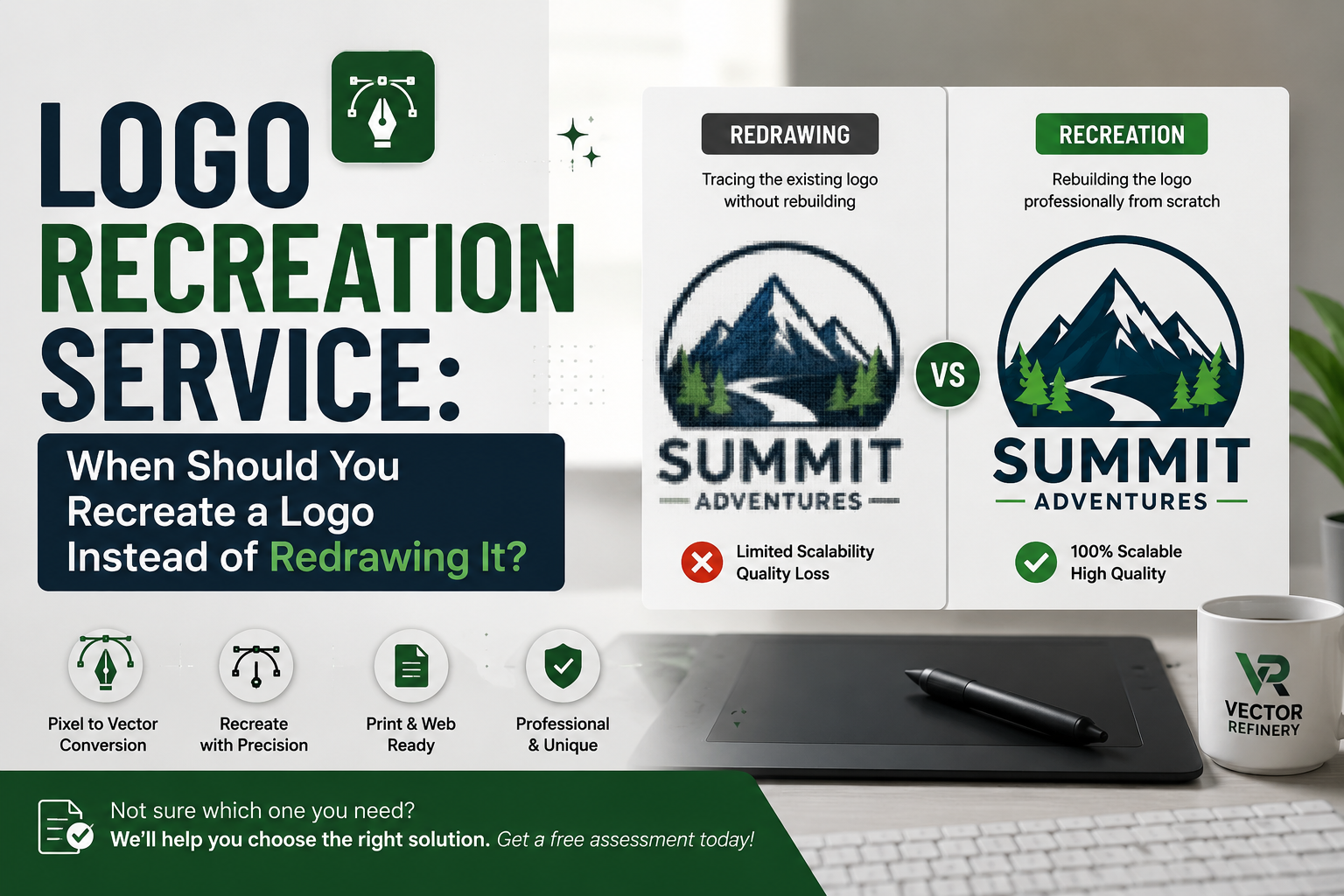
The first client needs a logo redraw — taking the existing design and faithfully reproducing it in clean vector format. The second client needs a logo recreation — rebuilding the logo from the ground up while preserving enough of the original intent to keep brand continuity.
Most people use these two terms interchangeably. In practice, they describe meaningfully different services with different processes, different outputs, and different implications for your brand. Understanding the distinction helps you get the right result the first time and avoid paying for work that does not solve your actual problem.
Redraw vs recreation — key differences
| Factor | Logo redraw | Logo recreation |
|---|---|---|
| Goal | Faithful reproduction of existing design in vector format | Rebuilding or updating a logo where straight redraw is not possible or sufficient |
| Source quality needed | Any raster file — PNG, JPG, screenshot, or scan | Works even from degraded, blurry, or damaged source material |
| Design changes made | ✗ None — exact reproduction only | ✓ Yes — updates, interpretation, and adaptation |
| Creative judgment required | Minimal — technical precision is the focus | Significant — artist makes design decisions throughout |
| Best when | Logo design is correct, only the file format is the problem | Logo is outdated, degraded, lost, or needs adaptation for new uses |
| Typical price | $25 – $45 at Vector Refinery | $45 – $85 at Vector Refinery |
| Output | AI, EPS, SVG, PDF, PNG — complete vector package | AI, EPS, SVG, PDF, PNG — complete vector package |
5 scenarios that require recreation not redraw
| # | Scenario | What this means | Service needed |
|---|---|---|---|
| 1 | Logo too degraded to trace | Worn patch, over-photocopied scan, faded signage photo — source lacks the detail needed for faithful reproduction | Recreation |
| 2 | Logo needs modernizing | Design looks dated — typography, colors, or overall style need refreshing while maintaining brand continuity | Recreation |
| 3 | New application needed | Logo designed for one context now needs reversed, single-color, or compact icon versions for new uses | Recreation |
| 4 | Elements have changed | Company name, tagline, or brand colors have been updated — existing files reflect the old version | Recreation |
| 5 | Files lost, only a photo remains | Original vector source is gone — the only reference is a blurry photograph or an old product image | Recreation |
Which service do I need? — quick decision guide
| My situation is… | I need | Starting price |
|---|---|---|
| I have a PNG or JPG — the design is fine, just the wrong format | Logo redraw | From $25 |
| My print shop or embroiderer rejected my file | Logo redraw | From $25 |
| I have a screenshot and need a proper vector file | Logo redraw | From $25 |
| My logo looks outdated and needs refreshing | Logo recreation | From $45 |
| My only reference is a blurry photo of an old sign | Logo recreation | From $45 |
| My original source files are completely lost | Logo recreation | From $45 |
| My company name or brand colors have changed | Logo recreation | From $45 |
| I need an embroidery-optimized version of complex artwork | Premium package | From $85 |
| I am not sure which one I need | Free assessment | $0 |
What Is Logo Redrawing?
Logo redrawing — also called logo vectorization or logo tracing — is the process of taking an existing logo and reproducing it faithfully in a professional vector format. The goal is accuracy: the output should look identical to the original, just built from clean vector paths instead of pixels.
This is the right service when your logo design is correct and complete but the file you have is not usable for production. You have a PNG that blurs when printed large. You have a JPG that the embroidery shop rejected. You have a screenshot taken from your website that falls apart at scale. The logo itself is fine. The file is the problem.
A professional redraw takes that unusable raster source and manually rebuilds every shape, color, and letterform as a clean vector file — AI, EPS, SVG, and PDF — that works perfectly in every production context from business cards to billboard-sized banners.
The emphasis throughout a redraw is on faithful reproduction. The vector artist is not making creative decisions about the logo. They are reconstructing what already exists, precisely and accurately, in a format that performs correctly in the real world.
What Is Logo Recreation?
Logo recreation is a broader, more involved process. It shares the end goal of a redraw — a production-ready vector file — but the starting point and the process are fundamentally different.
Recreation is called for when the existing logo cannot simply be reproduced. Maybe the logo design itself needs to be updated or modernized. Maybe the source material is so degraded — a worn emblem on an old uniform, a blurry photo of a sign, a decades-old letterhead scan — that faithful reproduction is not really possible from the available reference. Maybe the original files are entirely lost and the only reference is a low-quality photograph. Or maybe the brand has evolved and the logo needs to reflect that evolution while maintaining enough visual continuity to feel like the same brand.
In these cases, a vector artist is not just reconstructing shapes from a reference — they are making judgment calls about design intent, interpreting damaged or ambiguous source material, rebuilding elements that cannot be accurately traced, and in some cases designing new or updated elements that integrate with the existing brand identity.
The result is still a clean, professional vector file that is faithful to the brand. But faithful means something different in recreation than it does in redraw. A redraw is accurate to the pixels. A recreation is accurate to the brand intent.
The Five Scenarios That Require Recreation Rather Than Redraw
Knowing which service you actually need depends on your specific situation. Here are the five scenarios where logo recreation is the right answer, not simple vectorization.
Scenario 1: The Logo Is Too Degraded to Trace Accurately
Some logos arrive in genuinely unusable condition. A photo of a worn embroidered patch on a jacket. A scanned letterhead that has been photocopied so many times the fine details are gone. A faded storefront sign photographed from across a parking lot. A logo that was originally printed on a dark background and photographed with poor lighting.
In all of these cases, the source material does not contain enough information to redraw the logo accurately. The edges are too soft, the details are too degraded, and the colors are too compromised. A faithful redraw is not possible because the source does not reliably represent what the original logo actually looked like.
Recreation in this scenario involves the artist interpreting the damaged source material, making informed decisions about what the original design intent was, and rebuilding the logo in a way that is consistent with that intent — even where the source material is ambiguous or missing information.
This is a skill that goes beyond simple tracing. It requires design judgment, an understanding of logo design conventions, and the ability to make decisions that honor the brand while producing a technically clean result.
Scenario 2: The Logo Needs to Be Modernized
Brands evolve. A logo that was designed in 2005 may have served the business well for twenty years, but it now looks dated against competitors who have updated their visual identity. The typography feels old. The color palette is too muted for digital use. The overall style no longer reflects how the company wants to be perceived.
In this situation, straight vectorization produces a perfect reproduction of an outdated logo — which is not actually the outcome the client needs. They need a logo that looks right for 2026, not a pixel-perfect copy of something that looked right twenty years ago.
Logo recreation for modernization preserves the core elements of the original — the recognizable symbol, the color family, the general composition — while updating the execution to feel contemporary. Typography gets refreshed with cleaner, more current letterforms. Colors get refined to work better across digital and print applications. Proportions get adjusted for better legibility at small sizes.
The result is a logo that feels like the same brand but looks like it belongs in the current decade — with a complete, production-ready vector file as the output.
Scenario 3: The Logo Must Work for New Applications
Some logos were designed for a specific, limited context and have never needed to work elsewhere. A logo designed for a website header that is always dark blue on white has never needed a reversed version for dark backgrounds. A horizontal wordmark that looks great on a business card has never needed a compact square version for a social media profile photo.
When a brand expands into new contexts — merchandise, signage, embroidery, new digital platforms — the existing logo may simply not translate. It needs to be adapted, not just reproduced.
Recreation for application expansion involves taking the existing logo and building out versions that work across the new contexts: a reversed color version, a single-color version, a simplified icon version that works at very small sizes, a version with adjusted proportions for a specific production context. Each of these is a design decision that goes beyond faithful reproduction.
The output is a family of logo variations — all derived from the original, all consistent with the brand, all built as clean production-ready vector files.
Scenario 4: Elements of the Logo Have Changed
Sometimes only part of a logo needs to change. The company name has changed. The tagline is different. A color has been updated across the brand. A symbol has been retired or replaced. The existing logo files, if they exist at all, reflect the old version — not the current one.
Recreation in this context means rebuilding the logo with the new elements integrated correctly. This is not a simple text change — it often requires adjusting spacing, proportions, and visual weight to integrate the new elements in a way that looks deliberate and professionally designed rather than patched together.
The result is a current, correct version of the logo in complete vector format — reflecting the actual brand identity, not the outdated version.
Scenario 5: The Files Are Lost and the Only Reference Is a Low-Quality Photograph
This is one of the most common reasons businesses seek logo recreation services, and it is almost always discovered at the worst possible moment — when a print job is due, an embroidery order needs to be placed, or a new design agency asks for the source files and nobody can find them.
When the only available reference is a low-quality photograph — a blurry picture from a company anniversary party, a photo of a product label, a screenshot from a ten-year-old website archived on the Wayback Machine — the artist is working with much less information than a clean PNG or JPG would provide.
Recreation in this scenario is as much interpretation as tracing. The artist uses every clue available — the visible letterforms, the approximate color palette, the overall proportions — to reconstruct a logo that is as close as possible to the original while being technically sound as a vector file.
The caveat is honest: the result will not be identical to the original if the original is not available as a reference. But it will be a clean, professional, production-ready logo that is consistent with the brand and usable in every context the client needs.
Redraw vs. Recreation: How to Know Which One You Need
The simplest way to determine which service is right for your situation is to ask yourself one question: do you want a perfect copy of the existing logo, or do you need something more than a copy?
If the answer is a perfect copy — the design is exactly right, you just need it in a proper vector format — you need a professional redraw. This is faster, more straightforward, and less expensive than recreation because the creative decisions have already been made. The artist’s job is technical precision, not design judgment.
If the answer involves any element of updating, adapting, interpreting, or rebuilding — if the logo needs to change in any way, or if the source material is too degraded to reproduce accurately — you need recreation. This involves more time, more judgment, and correspondingly more investment. But the output is a logo that actually serves your current brand needs, not just a vector version of whatever you had before.
What Both Services Have in Common
Despite the differences, logo redraw and logo recreation share the same non-negotiable quality standards for the final output.
Both deliver a complete, production-ready vector file package. Both require manual, hand-built vector paths — not auto-trace shortcuts that produce files print shops reject. Both go through a quality review process that checks anchor point cleanliness, color separation, path direction, and file organization. Both are delivered in a complete format set — AI, EPS, SVG, PDF, and transparent PNG — that covers every production application.
The difference is in how much the artist contributes creatively to what those paths represent. A redraw is all craft. A recreation is craft plus design judgment.
What a Professional Logo Recreation Service Delivers
When you work with a professional logo recreation service like Vector Refinery, here is what the process actually looks like from your end.
Assessment first. Before any work begins, the team reviews your source material — however degraded or limited it may be — and gives you an honest evaluation of what is possible. If your source is a clear PNG and a straight redraw is the right answer, they tell you that. If the source requires interpretation and recreation, they tell you that too, with a clear explanation of what the process involves and what the result will look like.
Clear brief. The better the brief, the better the result. For recreation projects, any additional context helps enormously: old printed materials, photographs of the logo on physical objects, knowledge of the original colors or fonts, brand guidelines if they exist, and a clear description of how the logo should evolve if modernization is part of the scope.
Manual work throughout. Every shape is rebuilt by hand using Adobe Illustrator’s Pen tool. No auto-trace at any stage. This is the difference that matters for production quality — clean anchor points, smooth curves, proper color separation, organized file structure.
Review and revision. You see the result before it is final. If the recreation does not match your expectations or needs adjustment, revisions are included. The goal is a result that is exactly right, not just technically correct.
Complete file delivery. AI, EPS, SVG, PDF, transparent PNG, black and white version — everything you need for every application, organized clearly and delivered in a format you can use immediately.
How Much Does Logo Recreation Cost?
Logo recreation typically costs more than a straightforward redraw, because more work is involved. The price depends on the same factors that affect any vectorization project — complexity, number of colors, typography, and the scope of recreation required — but the starting point is higher because the artist is making design decisions, not just tracing.
At Vector Refinery, the pricing structure covers both services:
Basic — $25 Straightforward redraws of simple logos with flat colors and minimal complexity. Delivered within 48 hours.
Standard — $45 Business logos with multiple elements, text, and moderate complexity. Covers both faithful redraws and moderate recreation. Full file package included. Delivered within 24 hours.
Premium — $85 Complex artwork, significant recreation, degraded source material, embroidery optimization, or logos requiring substantial design judgment. Full file package, unlimited revisions, priority delivery in 12–24 hours.
If your project involves significant recreation — modernization, extensive interpretation of degraded material, or building out a full family of logo variations — the team will assess it and provide an exact quote before any work begins. You know what you are paying for before committing.
Why Vector Refinery for Logo Recreation
Vector Refinery handles both logo redraws and logo recreation with the same commitment to manual, professional quality. Every project starts with an honest assessment of what the source material allows and what the client actually needs — not a one-size-fits-all approach that treats every job the same regardless of complexity.
Over 500 completed projects. 5.0 client rating. Top Rated on Upwork. Packages starting at $25 with delivery in as little as 12 hours.
Whether your logo needs a faithful redraw or a thoughtful recreation, the result is the same: a clean, complete, production-ready vector file that works correctly in every context you need it — now and for years to come.
Upload Your Logo and Get a Free Assessment →Frequently Asked Questions
How do I know if I need a redraw or a recreation? If your logo design is correct and complete but the file format is wrong — you have a PNG or JPG and need a vector — you need a redraw. If the logo needs to change in any way, the source material is too degraded to reproduce accurately, or you need the logo adapted for new uses, you need recreation. When in doubt, upload your source material and describe your situation — the team at Vector Refinery will tell you which service is right before any payment is required.
Can you recreate a logo from a very old or damaged source? Yes, in most cases. Even significantly degraded sources — old scans, blurry photographs, worn physical items — can serve as the basis for a professional recreation. The artist interprets the design intent from whatever information is available. The more context you can provide (additional references, color information, font names), the more accurate the result.
Will the recreated logo look exactly like the original? For faithful redraws, yes — the goal is pixel-accurate reproduction in vector form. For recreation projects, the result will be consistent with the original brand intent but may differ in specific details, particularly where the source material is ambiguous or where modernization is part of the scope.
Do you handle font matching for logo recreation? Yes. Identifying and correctly matching the typeface used in a logo is a standard part of the recreation process. If the exact font is not identifiable, the closest available match is used or the letterforms are hand-redrawn as custom vector paths.
Can you recreate a logo and also update the colors to current brand standards? Yes. Color updates are a common part of logo recreation. Provide your current brand color codes — Pantone, hex, or CMYK — with your order and the recreated logo will be built to those specifications.
What if the only reference I have is a photograph of the logo on a product? This is a very common starting point and it is workable. A clear, well-lit photograph gives the artist enough information to reconstruct the logo accurately. The higher the quality of the photograph, the more accurate the result. If you have multiple reference photographs from different angles, include all of them.
Published by Vector Refinery — Professional Logo Recreation Service and Manual Vectorization. Visit vectorrefinery.com to upload your source material and get a free assessment today.
