
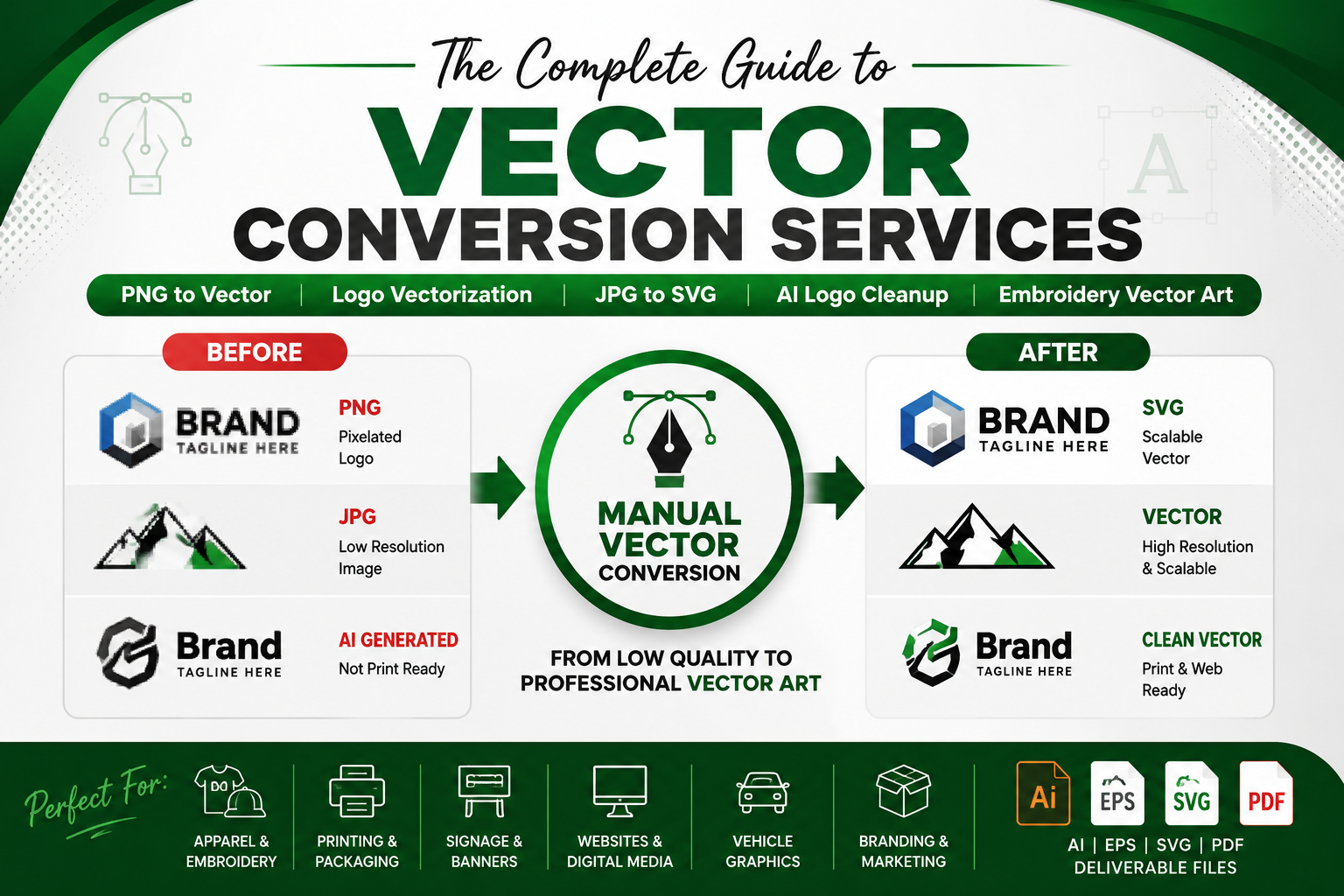
In today’s digital and print-driven world, high-quality artwork is essential for building a professional brand. Whether you’re creating business cards, vehicle wraps, signage, embroidered apparel, websites, packaging, or promotional products, the quality of your graphics can significantly impact how your brand is perceived.
One of the most common challenges businesses face is working with low-resolution artwork. Many companies only have a PNG logo, a JPG image, a screenshot, or an AI-generated logo that isn’t suitable for professional production. These files often become blurry when enlarged, fail quality checks at print shops, or create problems during embroidery and manufacturing.
This is where professional vector conversion services become essential.
Vector artwork provides clean, scalable, and editable graphics that can be used across virtually every printing and digital application. Whether you need PNG to Vector Conversion, Logo Vectorization, JPG to SVG Conversion, AI Logo Cleanup, or Embroidery Vector Art, converting your artwork into a professional vector format ensures long-term usability and consistent branding.
This comprehensive guide explains everything you need to know about vector conversion services, how they work, why they matter, and how they help businesses create production-ready artwork for professional use.
Vector Conversion Services Comparison
Choose the right vector conversion service based on your artwork type and final use.
| Service | Best For | Recommended Use | Output Files |
|---|---|---|---|
| PNG to Vector | Low-resolution PNG logos | Printing, signage, branding | AI, EPS, SVG, PDF |
| Logo Vectorization | Blurry or pixelated logos | Professional brand files | AI, EPS, SVG, PNG |
| JPG to SVG | JPG artwork and graphics | Web, Cricut, digital use | SVG, EPS, PDF |
| AI Logo Cleanup | AI-generated logos | Clean editable vector files | AI, EPS, SVG, PDF |
| Embroidery Vector Art | Logos for embroidery prep | Hats, shirts, uniforms | AI, EPS, SVG, PDF |
What Is Vector Artwork?
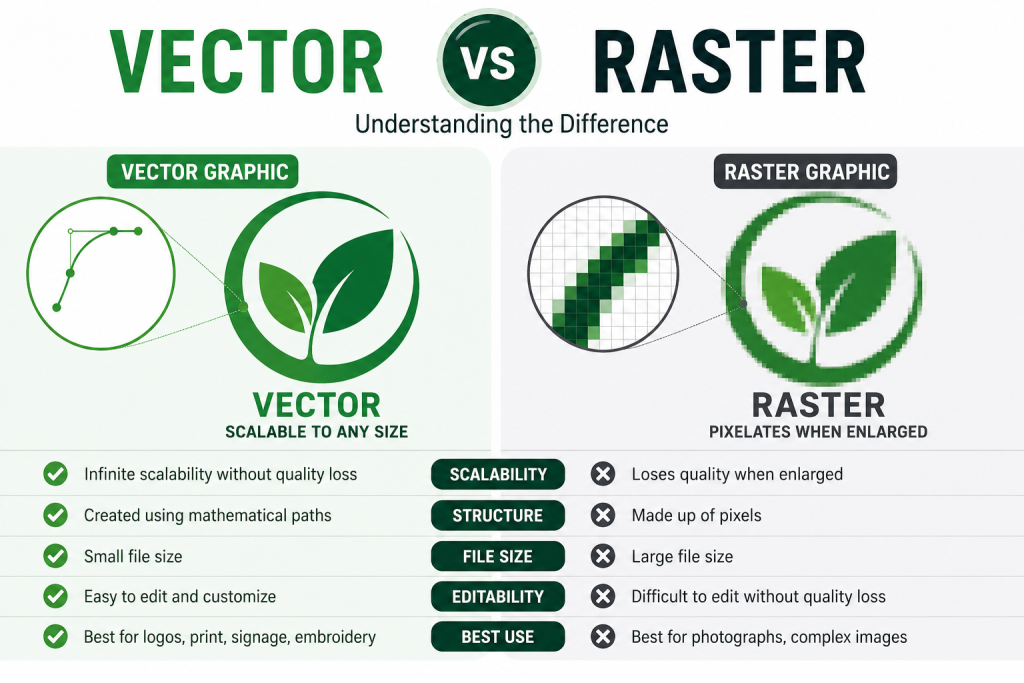
Vector graphics are images created using mathematical paths rather than pixels.
Unlike raster images such as JPG, PNG, GIF, or BMP files, vector graphics can be scaled infinitely without losing quality.
Common vector file formats include:
- AI (Adobe Illustrator)
- EPS
- SVG
- PDF (Vector-Based)
Because vector artwork is built using paths, lines, curves, and shapes, it remains perfectly sharp at any size.
A logo printed on a business card and the same logo displayed on a billboard can use the exact same vector file without losing quality.
| Feature | Vector Graphics | Raster Graphics |
|---|---|---|
| Scalability | Infinite without quality loss | Loses quality when enlarged |
| File Types | AI, EPS, SVG, PDF | PNG, JPG, GIF, BMP |
| Editing | Easy and flexible | Limited editing options |
| Print Quality | Excellent for professional production | Depends on image resolution |
| Best For | Logos, signs, embroidery, print artwork | Photos and simple digital images |
Why Vector Graphics Are Important
Professional vector graphics offer several advantages:
Infinite Scalability
Vector artwork can be enlarged without becoming blurry or pixelated.
Print Quality
Commercial printers require clean vector files for professional output.
Easy Editing
Colors, shapes, and text can be modified easily.
Smaller File Sizes
Many vector formats are more efficient than large raster files.
Production Compatibility
Vector files are preferred for:
- Screen printing
- Embroidery
- Signage
- Vehicle wraps
- Packaging
- Promotional products
PNG to Vector Conversion
What Is PNG to Vector Conversion?
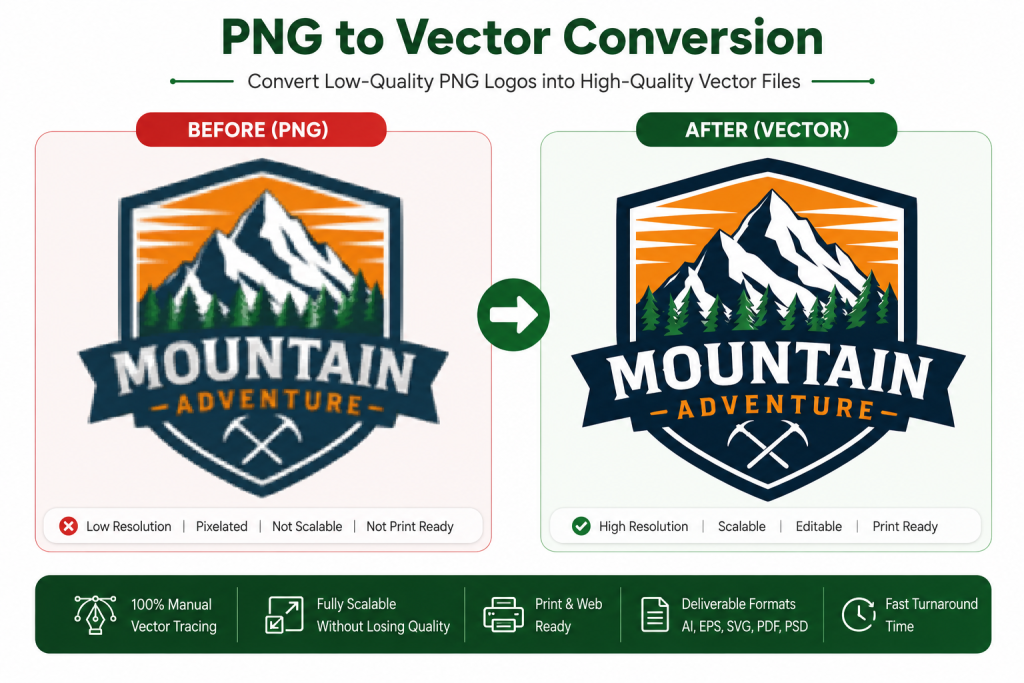
PNG to Vector Conversion is the process of recreating a PNG image as vector artwork.
PNG files are raster images made from pixels.
While PNG files support transparency and are useful for web graphics, they are not ideal for large-scale printing or manufacturing applications.
When enlarged, PNG images often become:
- Blurry
- Jagged
- Pixelated
- Unprofessional
Professional PNG to Vector Conversion solves these problems by rebuilding the artwork using clean vector paths.
Why Businesses Need PNG to Vector Conversion
Many businesses receive logos from:
- Social media profiles
- Screenshots
- Website downloads
- Email attachments
- Old files
These logos are often available only as PNG images.
Unfortunately, PNG files are rarely suitable for professional printing.
A printing company may reject a low-resolution PNG because it cannot produce sharp results.
By converting the artwork into vector format, businesses gain access to scalable and editable files that can be used across all marketing materials.
Common Uses for PNG to Vector Conversion
PNG to Vector Conversion is commonly required for:
- Business cards
- Banners
- Trade show displays
- Vehicle graphics
- Storefront signage
- Packaging
- Uniforms
- Promotional products
Benefits of Professional PNG to Vector Conversion
Clean Edges
Vector artwork eliminates pixelation.
Better Printing
Produces professional-quality output.
Future-Proof Branding
One vector file can be used for years.
Editable Artwork
Colors and elements can be updated easily.
Universal Compatibility
Works with most professional design and printing systems.
Logo Vectorization Service
What Is Logo Vectorization?
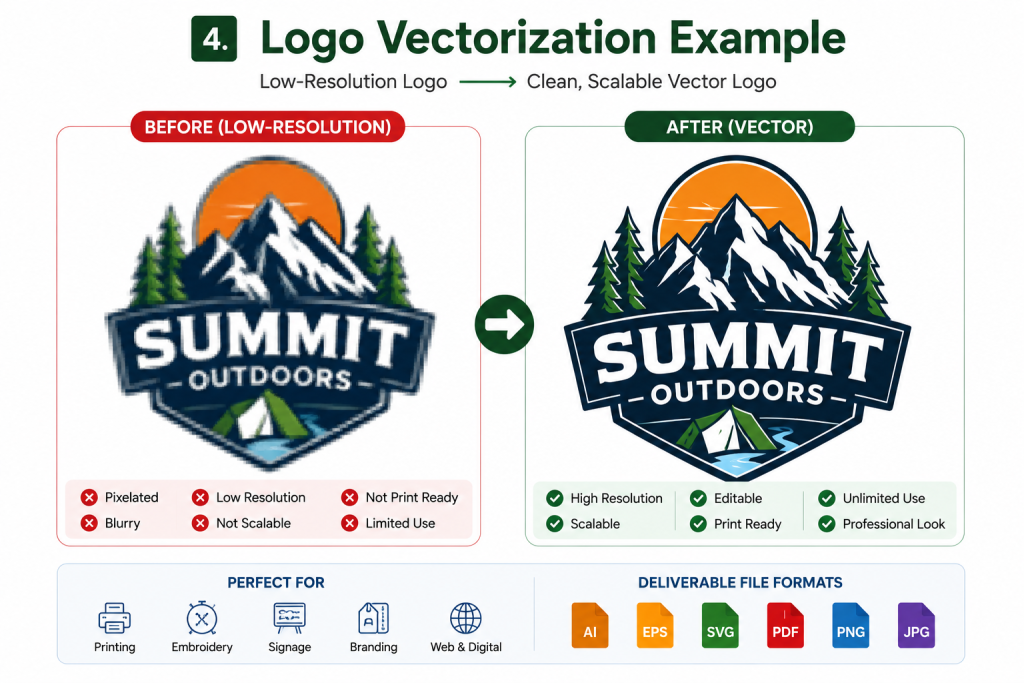
Logo Vectorization is the process of recreating a logo as clean, editable vector artwork.
Unlike automated tracing software, professional logo vectorization involves manually rebuilding the logo using vector paths.
This approach delivers far better quality and accuracy.
Why Logo Vectorization Matters
A logo represents the identity of a business.
Poor-quality logos create an unprofessional appearance and can negatively affect brand perception.
Businesses often need logo vectorization when:
- Original files are lost
- Only JPG or PNG files remain
- Logos need updating
- Large-scale printing is required
Problems With Low-Resolution Logos
Low-resolution logos can create:
- Blurry prints
- Poor embroidery results
- Signage production issues
- Difficult editing
- Brand inconsistency
Professional vectorization solves these problems.
Applications of Logo Vectorization
Vectorized logos are used for:
Printing
Business cards, brochures, catalogs, flyers.
Signage
Storefront signs, trade show graphics, banners.
Apparel
T-shirts, hats, uniforms.
Packaging
Product labels and packaging design.
Digital Media
Websites, mobile apps, social media.
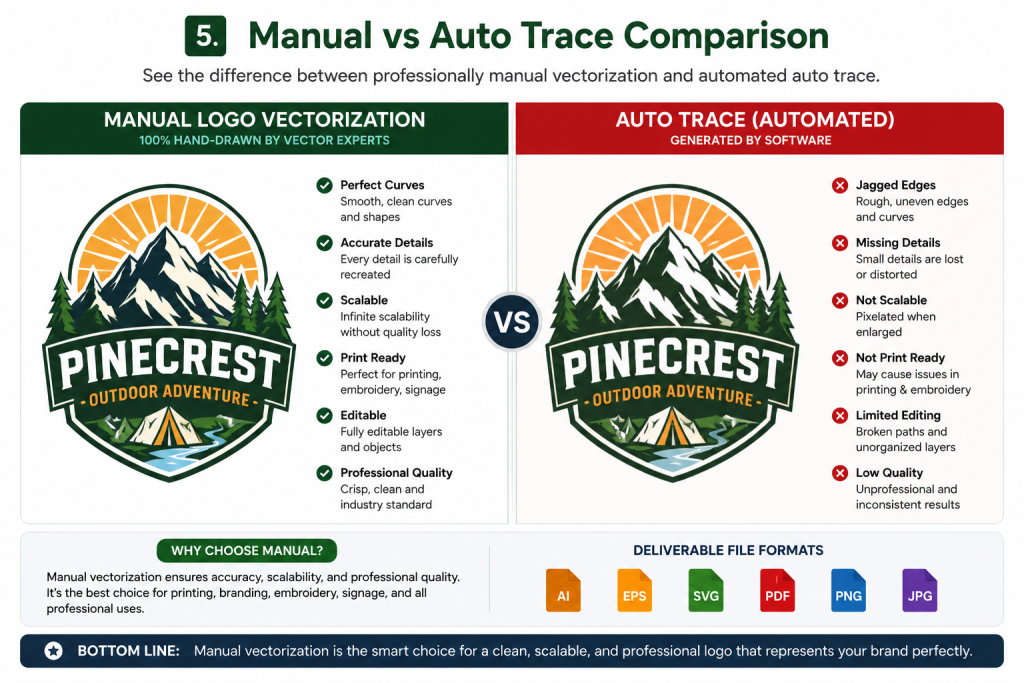
Manual Logo Vectorization vs Auto Trace
Many people use automatic tracing tools.
While convenient, auto-trace often creates:
- Thousands of unnecessary anchor points
- Rough edges
- Inconsistent curves
- Difficult-to-edit artwork
Manual vectorization produces:
- Smooth curves
- Clean geometry
- Professional-quality files
- Better scalability
For commercial use, manual vectorization is almost always the preferred option.
JPG to SVG Conversion
Understanding JPG Files
JPG files are among the most common image formats.
They are excellent for photographs but not ideal for logos or scalable graphics.
JPG files:
- Use compression
- Lose quality during editing
- Cannot scale effectively
- Often contain visible artifacts
What Is SVG?
SVG stands for Scalable Vector Graphics.
SVG files are vector-based and ideal for modern websites and digital applications.
Unlike JPG images, SVG files remain perfectly sharp regardless of screen size.
Benefits of JPG to SVG Conversion
Responsive Design
SVG graphics adapt beautifully to different devices.
Better Website Performance
SVG files are often lightweight.
Crisp Display
Perfect on Retina and high-resolution screens.
Easy Editing
Can be modified quickly.
SEO Benefits
Search engines can better interpret SVG content than traditional images in certain contexts.
Common Uses of SVG Files
SVG files are widely used for:
- Website logos
- Mobile applications
- User interfaces
- Icons
- Interactive graphics
- Responsive design
AI Generated Logo Cleanup
The Rise of AI-Generated Logos
Artificial Intelligence has transformed the design industry.
Many businesses now use AI logo generators to create initial logo concepts.
While AI tools can produce interesting designs, they often generate artwork that is not ready for professional production.
Common Problems With AI Logos
AI-generated logos frequently contain:
- Uneven curves
- Inconsistent spacing
- Broken geometry
- Low-quality exports
- Complex details
- Typography problems
These issues become obvious during printing or manufacturing.
Why AI Logo Cleanup Is Important
Professional AI Logo Cleanup transforms AI-generated concepts into production-ready brand assets.
This process often includes:
Path Cleanup
Removing unnecessary points.
Typography Refinement
Improving spacing and readability.
Shape Correction
Balancing geometric relationships.
Simplification
Preparing artwork for production methods.
File Reconstruction
Creating clean vector versions.
Benefits of AI Logo Cleanup
Businesses receive:
- Cleaner logos
- Better scalability
- Improved readability
- Professional appearance
- Print-ready artwork
Embroidery Vector Art
Why Embroidery Requires Special Artwork
Embroidery is one of the most demanding production methods.
Unlike printing, embroidery uses physical thread.
Every detail must be translated into stitches.
Because of this, artwork often requires modification before digitizing.
Common Embroidery Problems
Many logos are not embroidery-friendly.
Common issues include:
- Thin lines
- Tiny text
- Complex gradients
- Small details
- Dense artwork
These elements often fail during stitching.
What Is Embroidery Vector Art?
Embroidery Vector Art is artwork specifically prepared for embroidery production.
The goal is to simplify and optimize graphics before digitization.
Embroidery Artwork Optimization
Removing unnecessary complexity.
Professional embroidery artwork typically includes:
Simplified Shapes
Increased Line Thickness
Ensuring lines stitch correctly.
Improved Spacing
Preventing thread overlap.
Reduced Color Complexity
Making production easier.
Industries That Need Embroidery Vector Art
Embroidery artwork is commonly used by:
- Clothing brands
- Sports teams
- Corporate businesses
- Schools
- Nonprofits
- Promotional product companies
Vector Conversion for Printing
Professional printers strongly prefer vector files.
Vector artwork ensures:
- Accurate colors
- Clean edges
- Sharp output
- Reliable production
Whether producing packaging, signage, labels, or promotional materials, vector graphics provide the best results.
Industries That Depend on Vector Conversion Services
Vector conversion is essential across many industries.
Printing Companies
Require print-ready files.
Sign Shops
Need scalable graphics.
Marketing Agencies
Need editable brand assets.
Embroidery Businesses
Need clean artwork for digitizing.
Manufacturers
Need production-quality artwork.
E-Commerce Brands
Need professional logos and packaging.
How to Choose the Right Vector Conversion Service
When selecting a vector conversion provider, look for:
Avoid services that rely entirely on automatic tracing software.
Frequently Asked Questions
What is the best vector file format?
AI, EPS, and SVG are among the most widely used vector formats.
Can a blurry logo be converted into vector format?
Yes. Professional manual vectorization can recreate low-quality logos into clean vector artwork.
Is SVG better than PNG?
For scalability and web performance, SVG is generally superior.
Can AI-generated logos be improved?
Yes. AI Logo Cleanup can significantly improve quality and usability.
Do printers prefer vector files?
Absolutely. Vector files provide the highest-quality printing results.
Is vector artwork required for embroidery?
In most cases, yes. Clean vector artwork helps produce accurate embroidery files.
Conclusion
Professional vector conversion services play a critical role in modern branding, printing, embroidery, signage, packaging, and digital design.
Whether you need PNG to Vector Conversion, Logo Vectorization, JPG to SVG Conversion, AI Logo Cleanup, or Embroidery Vector Art, investing in professional manual vector conversion ensures your artwork remains scalable, editable, and production-ready.
A properly created vector file becomes a long-term business asset that can be used across virtually every application without quality loss. By choosing professional vector conversion services, businesses can maintain brand consistency, improve production quality, and avoid costly artwork problems in the future.
